Aircraft with freshly overhauled engines command premium prices—that much is well-established. But does engine condition affect more than just price? Specifically, do aircraft with low engine hours (SMOH) sell faster and more reliably than those approaching their Time Between Overhaul (TBO)?
We analyzed 24,914 aircraft to answer this question, tracking their outcomes through FAA registration changes to determine which aircraft actually sold, and how quickly, versus those that were withdrawn from the market. What we found is both subtle and significant: engine hours do affect sale probability, but the effect is smaller than you might expect. In a complex market where price, condition, location, timing, and countless other factors all matter, we can still detect the signal of engine condition—even when it’s buried in the noise.
The decision to overhaul engines before selling is one of the most consequential choices an aircraft owner faces. A typical engine overhaul can cost upwards of $75,000 per engine. Conventional wisdom suggests fresh engines should make aircraft more marketable—but is this actually true in the data?
For sellers, understanding the marketability impact of engine hours directly informs financial strategy. If fresh engines significantly improve sale probability, the overhaul investment might pay for itself. Conversely, if the effect is minimal, sellers might be better off just pricing aircraft with high-time engines appropriately.
For buyers, this analysis reveals market dynamics that affect purchase decisions. Aircraft with high-time engines might represent better value if priced correctly, but they also carry higher risk of extended time on market if the seller is unrealistic about pricing.
We analyzed 24,914 aircraft with complete data on engine hours (SMOH), sale outcomes, and time on market, controlling for how far each aircraft was priced above or below its predicted market value, aircraft age, total airframe time (AFTT), interior and exterior quality scores, listing year, make/model, and aircraft category. Each aircraft was tracked through FAA registration changes to determine whether it sold (registration transferred within 90 days of delisting) or was withdrawn.
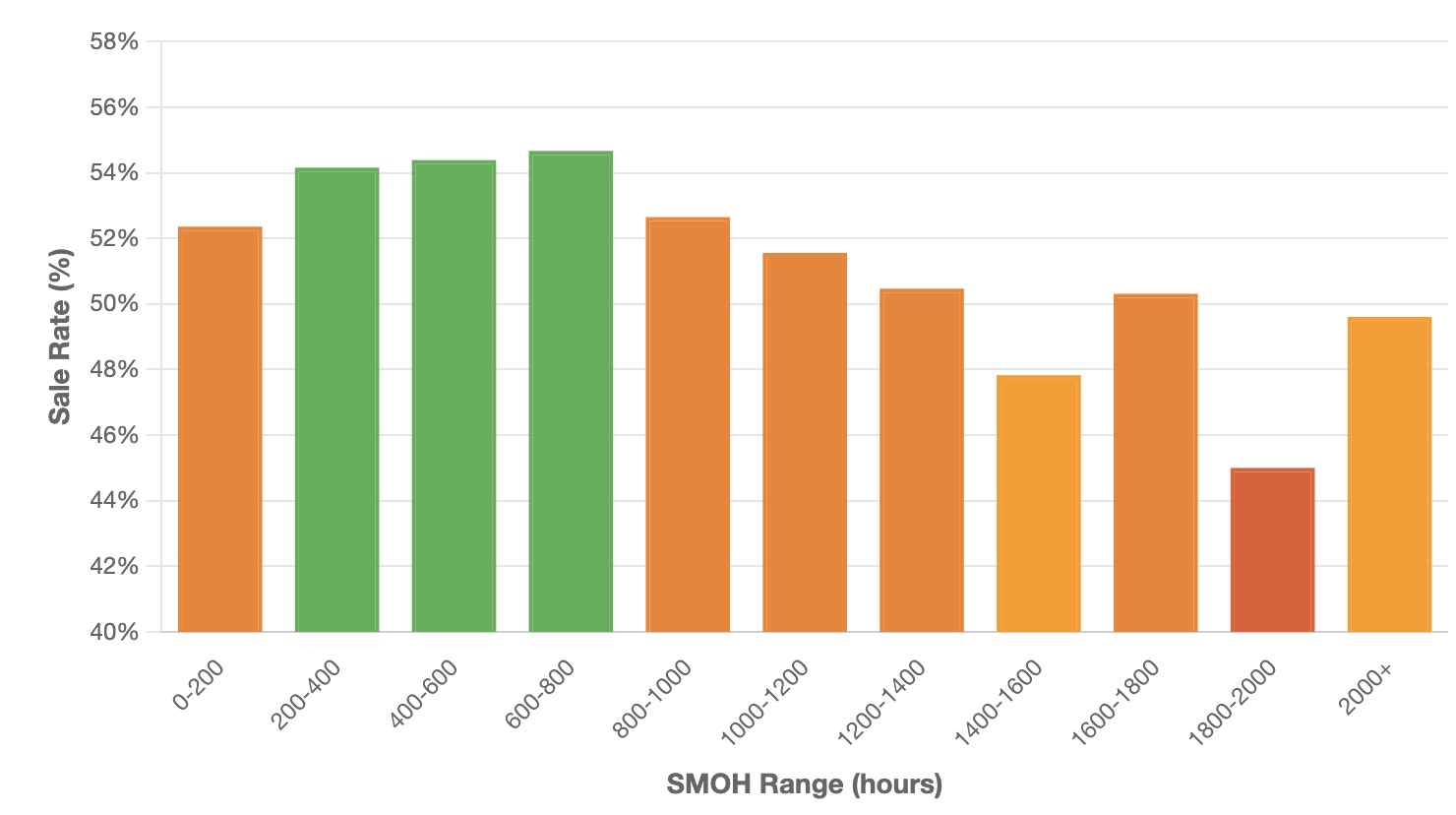
We categorized engine hours in two ways: absolute ranges (Fresh: 0-500 hours, Comfort: 500-1200, Anxiety: 1200-1800, Cliff: 1800+) and TBO-relative ranges (comparing engine hours to each aircraft’s typical Time Between Overhaul). We also performed a dose-response analysis — borrowed from medicine, this asks whether bigger "doses" produce proportionally bigger effects. Here, the "dose" is engine hours and the "response" is the sale rate. We binned aircraft into 200-hour SMOH ranges and checked whether each step up in hours produced a corresponding step down in sale probability. A clean dose-response curve is strong evidence the effect is real, not an artifact of how we drew the Fresh/Comfort/Anxiety/Cliff cutoffs.
For sale probability analysis, we used logistic regression controlling for price deviation from predicted value, aircraft age, total flight time, quality scores, make/model, listing year, and aircraft category. For time on market, we restricted to sold aircraft only and used linear regression with the same controls - and for the number of days, we tracked the total number of days the aircraft were listed on the open market (i.e. time it was for sale, notably distinct from the time between being listed and the time the registration actually changed, which can be several more months, and is less directly a measure of market velocity).
The data reveals a clear but modest effect of engine hours on sale probability, with no significant effect on time on market.
Sale Probability: A Real but Modest Effect
Aircraft with fresh engines (0-500 hours SMOH) have a 53.7% sale rate, compared to 47.6% for aircraft approaching TBO (1800+ hours). This 6.1 percentage point difference is modest, but statistically significant.
The effect becomes clearer when we look at odds ratios from logistic regression. Compared to the “Comfort” zone (500-1200 hours), aircraft in the “Anxiety” zone (1200-1800 hours) have 16.3% lower odds of sale, and aircraft in the “Cliff” zone (1800+ hours) have 28.4% lower odds. These effects are highly statistically significant (p<0.001).
The continuous relationship is also clear: each additional 100 hours of SMOH reduces the odds of sale by 1.66%.
The dose-response curve confirms this pattern. Plotting sale rate against the average engine hours in each 200-hour bin produces a clean downward slope: as the "dose" of engine hours rises, the "response" — the share of aircraft that successfully sell — falls in lockstep (correlation r = -0.77, p = 0.006). Sale rates peak around 600-800 hours SMOH (54.7%) and fall steadily to 45.0% for aircraft in the 1800-2000 hour range. That's the signature of a real underlying effect: not a single cliff at one threshold, but a gradual, monotonic decline as engines accumulate hours.
Time on Market: No Significant Effect
Surprisingly, engine hours don’t significantly affect how quickly aircraft sell, conditional on actually selling. The median time on market is remarkably consistent across all SMOH categories: 23-24 days. Even aircraft in the Cliff zone (1800+ hours) have a median time on market of 23 days—essentially identical to fresh engines.
This suggests that engine hours affect whether aircraft sell, but not how quickly they sell.
TBO-Relative vs Absolute Categorization
The TBO-relative analysis reveals similar patterns but with nuances. Aircraft in the “Early” zone (<50% of TBO) have 16.3% higher odds of sale compared to the “Mid” zone, while aircraft in the “Cliff” zone (>90% of TBO) have 18.9% lower odds. This suggests the effect is somewhat model-specific—what constitutes “high time” depends on the aircraft type.
The effects we detect are real and statistically significant, but they’re smaller than intuition might suggest. Why?
The aircraft market is extraordinarily complex. Sale outcomes depend on price, condition, location, timing, seasonality, make/model popularity, buyer preferences, seller motivation, and countless other factors. Engine hours are just one piece of this puzzle.
When we control for all these other factors, the effect of engine hours becomes visible—but it’s competing with many other signals. An overpriced aircraft won’t sell regardless of engine condition. A well-priced aircraft in a desirable location might sell quickly even with high-time engines.
This complexity is why the effects are modest. Engine hours matter, but they don’t dominate outcomes. The 6.1 percentage point difference between fresh and high-time engines is meaningful, but it’s not the only factor buyers consider.
The fact that we can detect this signal at all—with high statistical confidence, across 24,914 aircraft, controlling for numerous confounding factors—demonstrates both the rigor of our analysis and the reality of the effect. In a noisy market, finding a consistent effect that persists across models, categories, and time periods is meaningful.
For sellers, this means engine condition does affect marketability, but it’s not the only factor. Pricing accurately, maintaining the aircraft well, and marketing effectively all matter at least as much. For buyers, it means high-time engines do carry some marketability risk, but it’s a modest risk that can be managed through appropriate pricing.
Engine hours do affect aircraft market outcomes, but the effect is modest. Fresh engines (0-500 hours) have about 6 percentage points higher sale probability than high-time engines (1800+ hours), with a clear dose-response relationship: each 100 hours of SMOH reduces sale odds by about 1.66%.
However, engine hours don’t significantly affect time on market for aircraft that do sell. The median time on market is 23-24 days across all SMOH categories, suggesting that engine condition affects whether buyers are found, but not how quickly sales close once buyers are found.
These findings have practical implications. For sellers, fresh engines do improve marketability, but the effect is modest enough that overhauling before sale might not always be the right financial decision. For buyers, high-time engines do carry some marketability risk, but it’s manageable with appropriate pricing.
Most importantly, these findings demonstrate our ability to find signal in noise. In a complex market with countless confounding factors, we can detect the subtle but real effect of engine condition on outcomes. This capability—combining comprehensive data, accurate outcome tracking, and rigorous statistical analysis—is what sets Windsock.ai apart.
The market speaks through data. We’re listening.