.png)
It's a question that haunts every aircraft owner approaching TBO: If I'm planning to sell anyway, should I spring for the overhaul first? The intuition is usually right. You won't get all that money back. But how much do you actually lose? And is it ever worth it?
We built a model to answer this question empirically, analyzing thousands of aircraft transactions to understand the true economics of pre-sale engine overhauls.
We used Windsock's ML-powered valuation model to analyze 8,400+ individual aircraft across 282 make/model combinations. For each aircraft type, the model estimated market values at various engine times, allowing us to isolate the price premium buyers actually pay for fresh engines (SMOH, Since Major Overhaul at 0 hours) versus high-time engines approaching TBO.
We then cross-referenced these price differentials against actual engine overhaul costs from 399 documented overhauls across different engine types and shops. The final analysis matched 51 make/model combinations where we had robust data on both sides of the equation.

Overhaul Records
To ensure meaningful results, we filtered out statistical outliers where the engine value differential represented less than 15% or more than 85% of the aircraft's total value, edge cases that typically reflect data anomalies or aircraft with unusual circumstances rather than market norms.
Before diving into the overhaul economics, it's worth understanding just how significant the engine is to an aircraft's total value. The chart below shows the distribution of SMOH price differentials as a percentage of aircraft value across all 282 make/models we analyzed.
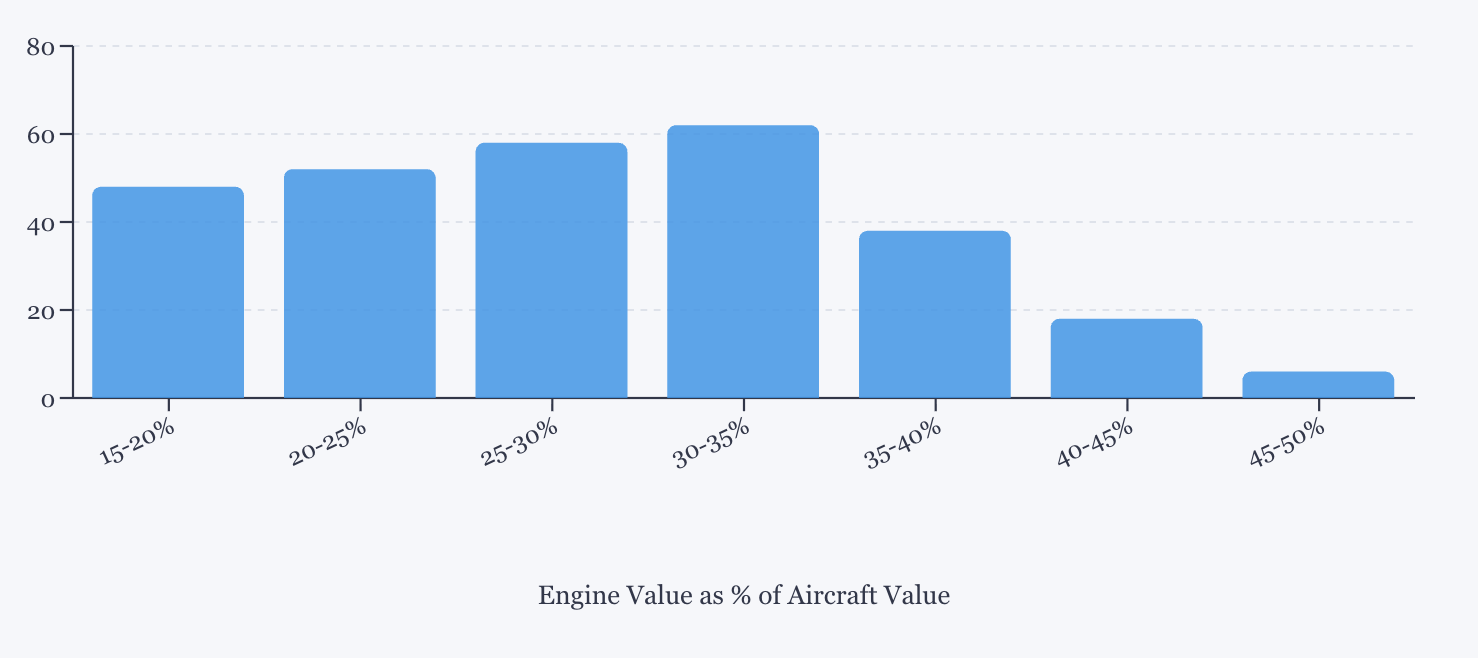
The median sits around 28-30%; meaning for a typical piston aircraft, the difference between a freshly overhauled engine and one at TBO represents roughly a third of the aircraft's value. This is a huge chunk of the transaction, which is precisely why the overhaul-or-sell decision matters so much.

Rather than cherry-pick winners and losers, let's look at the full distribution of outcomes. The histogram below shows the spread of returns on pre-sale engine overhauls; how much of your overhaul investment you can expect to recoup (or lose) at sale.
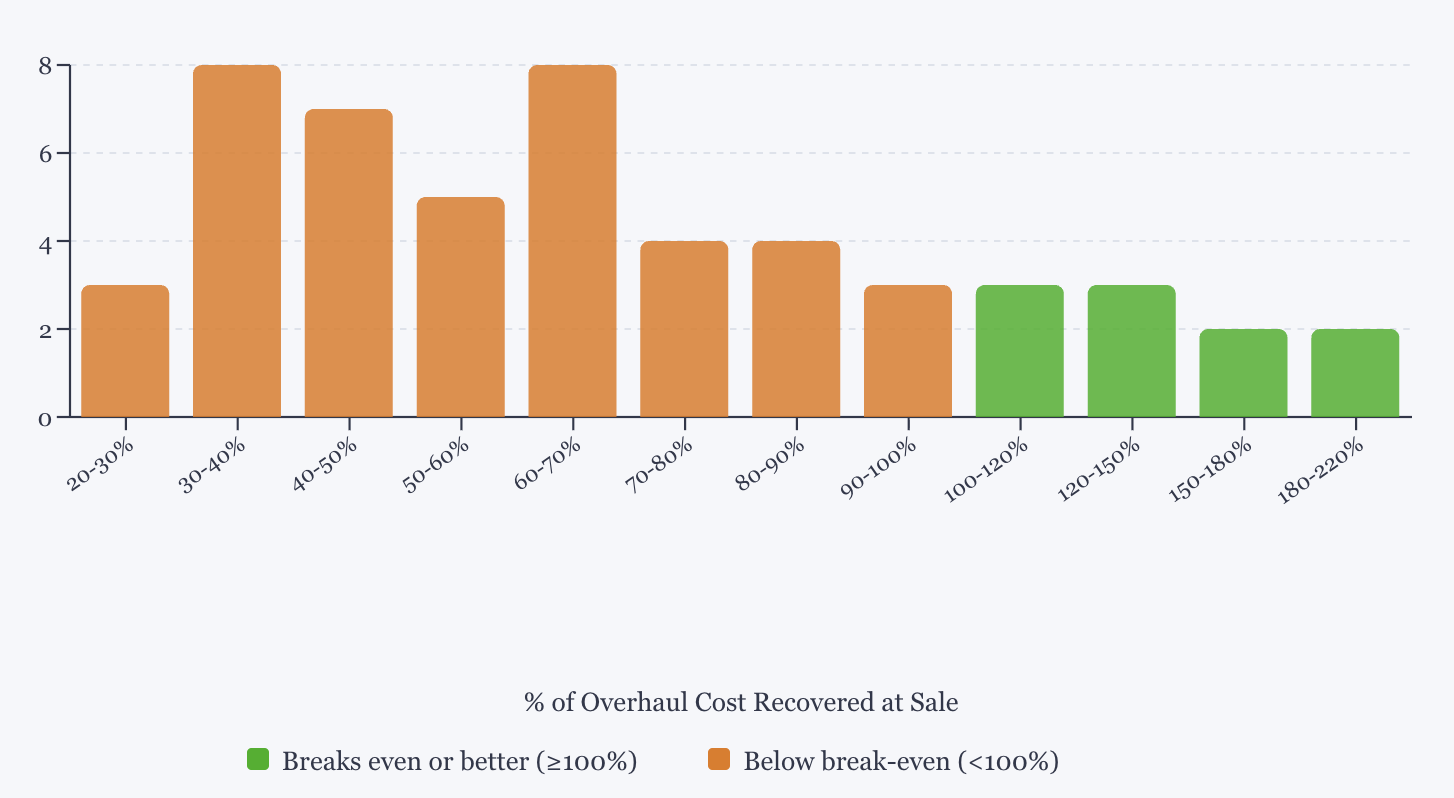
The distribution is heavily skewed negative. The median overhaul recoup is 66%, meaning a typical owner loses about a third of their overhaul investment at sale. But notice the shape: while losses cluster heavily in the -30% to -70% range, there's a meaningful tail of aircraft where overhauls actually pay off.

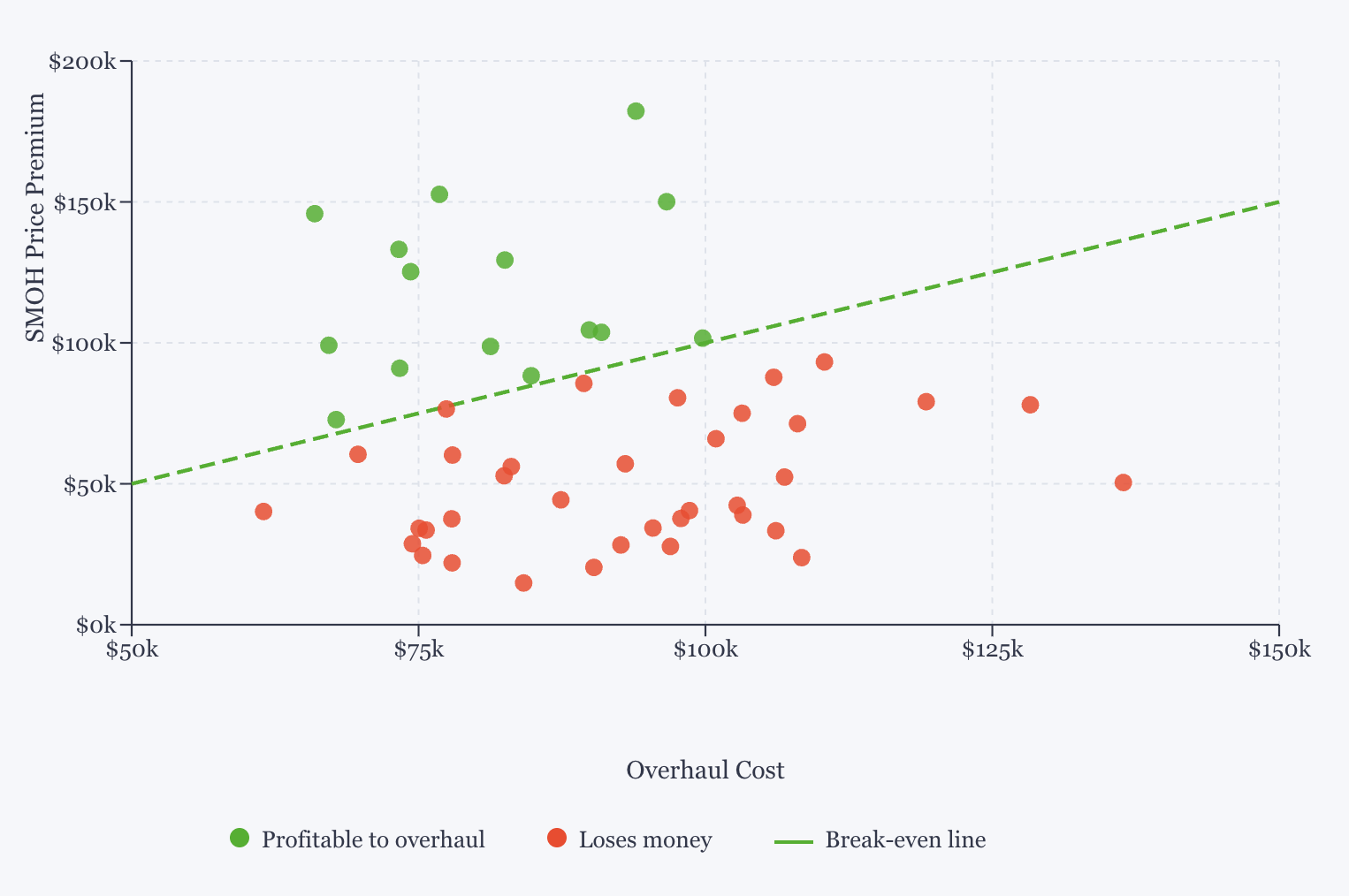
The scatter plot below shows the raw relationship. Each dot represents a different aircraft type. The diagonal line marks break-even, points above it indicate you'd make money overhauling; points below mean you're leaving money on the table. The further below that line, the worse the deal.
Real estate investors have long understood that home improvements rarely return 100% of their cost at sale. A $50,000 kitchen remodel might add $35,000 to your home's value, a 70% return. You do it because you want a nicer kitchen to live in, not because it's a good investment.
Engine overhauls follow the same pattern, but with worse odds. In expectation, you should plan to lose about a third of your overhaul investment at sale. The rare exceptions, high-demand aircraft like Cirrus SR22s, Diamond DA40s, and Beechcraft Barons are like bathroom additions in hot real estate markets: sometimes the math works, but you shouldn't count on it.
The expected value calculation: If you're selling an "average" aircraft, multiply your overhaul quote by 0.66 to estimate how much of it you'll actually recoup. A $90,000 overhaul returns roughly $60,000 in added sale price.
You're effectively paying $30,000 for the privilege of selling a fresh-engine aircraft.
This doesn't mean you should never overhaul before selling. If you're flying a high-demand aircraft where buyers specifically seek fresh engines, if market conditions favor turnkey aircraft, or if a runout engine is genuinely spooking buyers away, the calculation shifts. But absent those factors, the data strongly suggests selling as-is and letting the buyer decide.
Your instinct is correct. In seven out of ten cases, overhauling before sale means leaving $20,000-$30,000 on the table. Think about it in expectation: the median owner loses 34% of their overhaul investment. Unless you're selling a high-demand aircraft where fresh engines command outsize premiums, the rational move is to sell with time on the engine, price accordingly, and let the next owner make their own engine decisions.
Analysis based on Windsock AI's ML valuation model, analyzing 8,400+ aircraft across 282 make/models, with engine overhaul cost data from 399 documented overhauls. Price differentials represent the market premium for SMOH (0 hour) engines versus high-time engines approaching TBO.